

-
FrostMEISTER 3in1 – KIT 400ml (two-pack) + HP/LP adapter
Supplier:R134a i R1234yfRegular price €46,99 EURRegular price€51,99 EURPromotional price €46,99 EUROn sale -
FrostMEISTER 3in1 – KIT 400ml + HP/LP adapter
Supplier:R134a i R1234yfRegular price €38,99 EURRegular price€43,49 EURPromotional price €38,99 EUROn sale -
FrostMEISTER 3in1 – two-pack 800ml
Supplier:R134a i R1234yfRegular price From €27,99 EURRegular price€30,49 EURPromotional price From €27,99 EUROn sale -
FrostMEISTER 2in1 – two-pack 800ml
Supplier:R134a i R1234yfRegular price From €24,99 EURRegular price€27,49 EURPromotional price From €24,99 EUROn sale -
FrostMEISTER hose with pressure gauge
Supplier:Bez adapteraRegular price €12,49 EURRegular price -
FrostMEISTER 2in1 – KIT 800ml (two-pack)
Supplier:R134a i R1234yfRegular price From €34,49 EURRegular price€41,99 EURPromotional price From €34,49 EUROn sale -
FrostMEISTER 3in1 – KIT 800ml (two-pack)
Supplier:R134a i R1234yfRegular price From €38,99 EURRegular price€45,49 EURPromotional price From €38,99 EUROn sale -

 On sale
FrostMEISTER 2in1 – KIT 400ml
Supplier:R134a i R1234yfRegular price From €24,69 EURRegular price€32,49 EURPromotional price From €24,69 EUROn sale -

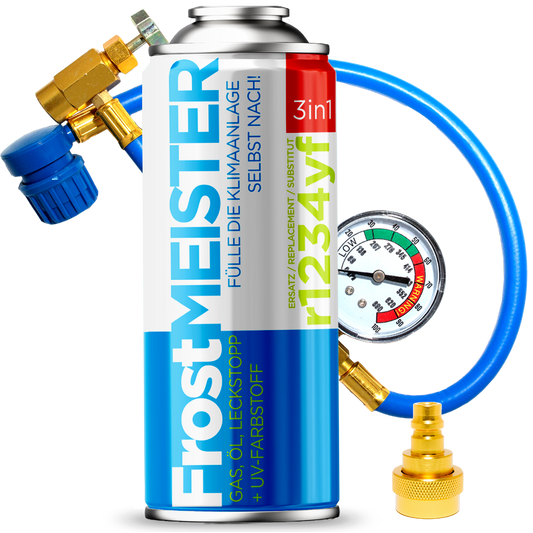
FrostMEISTER 3in1 R134a/R1234yf - KIT for self-refilling car air conditioning with sealant 400 ml
Supplier:R134a i R1234yfRegular price From €28,99 EURRegular price€36,49 EURPromotional price From €28,99 EUROn sale -

 On sale
FrostMEISTER 2in1 400ml
Supplier:R134a i R1234yfRegular price From €16,99 EURRegular price€18,99 EURPromotional price From €16,99 EUROn sale -
FrostMEISTER 3in1 - Gas for self-refilling air conditioning with sealant 400ml
Supplier:R134a i R1234yfRegular price From €18,99 EURRegular price€20,99 EURPromotional price From €18,99 EUROn sale







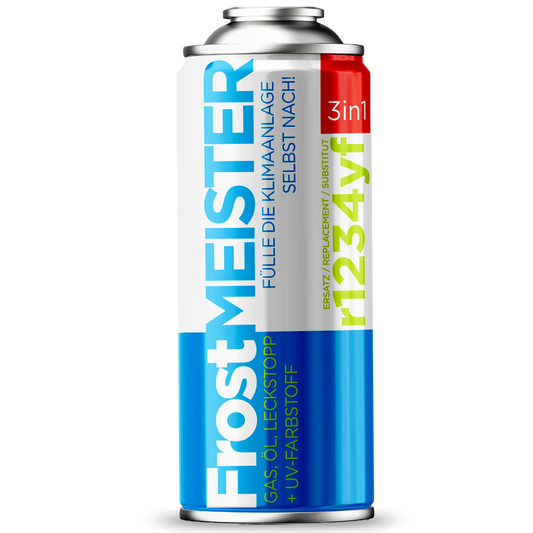
Gas for car air conditioning systems: Refrigerant in a 400 ml can
Our refrigerant is available in a single 400 ml can and in a twin pack. The cans are intended for those who already have a filling hose with a pressure gauge. This is usually the case if you have previously filled your air conditioning system using a FrostMEISTER kit.
Every car air conditioning system loses about 10% of its refrigerant per year. After two or three years, the amount is often insufficient. The air from the vents then remains lukewarm. With a can of refrigerant for air conditioning systems, you can refill the missing amount yourself, without an appointment at a garage.
All cans contain UV dye. It circulates through the system with the refrigerant. A UV lamp will later show you where the refrigerant is leaking.
If you don't already have a filling hose with a pressure gauge, it's best to choose a refill kit. It contains refrigerant, hose, and pressure gauge in one package. Buying an individual can, on the other hand, saves you money because you can continue using your existing accessories.
R134a refrigerant for vehicles from 1995 to 2016
Vehicles manufactured between 1995 and 2016 typically use the refrigerant R-134a. We offer R-134a refrigerant for these cars in 400 ml cans and in twin packs. It is available as a 2-in-1 and a 3-in-1.
You can find out if your car uses R-134a on the sticker under the hood. It's usually located at the front or near the radiator. This sticker indicates the refrigerant that was filled at the factory. Compare this information with the label on our can. If they match, the refrigerant is compatible with your car.
The refrigerant works with both manual and automatic climate control systems. Both systems use the same basic components. It can also be used to fill hybrid cars that use R-134a.
If a different refrigerant is already in the system, that's not a problem. The only important thing is that the type on the label matches your vehicle. So, for a car with R-134a, always choose the can containing R-134a, regardless of who last filled the system.
R1234yf refrigerant for vehicles manufactured from 2017 onwards
From model year 2017 onwards, R-1234yf is the standard refrigerant in new cars. We offer R-1234yf refrigerant for these vehicles. This variant is also available as a 2-in-1 and a 3-in-1, in 400 ml cans and in twin packs.
Check the type of your system in the same way as with older vehicles. The sticker under the hood shows which refrigerant was filled at the factory. If it says R-1234yf, choose the can containing R-1234yf. If you can't find a sticker, the year of manufacture in your vehicle registration document will help.
Many hybrid and electric cars use R-1234yf. You can also fill these vehicles with our refrigerant. The only requirement is that the refrigerant on the sticker matches the label on the can.
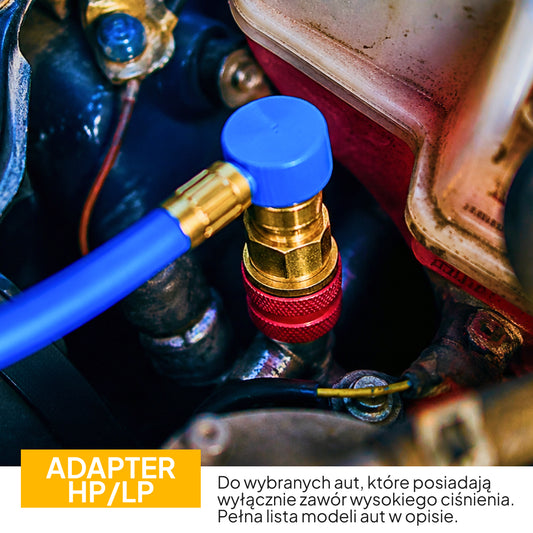
The accessories also include an adapter for R-1234yf. Some newer models require an additional HP/LP adapter, for example, the Nissan Qashqai (2015, 2016) and Mazda models from 2015 onwards. Check your model before purchasing; this will ensure the filling hose fits on the first try.
2-in-1 or 3-in-1: Which gas is suitable for air conditioners?
Both versions contain refrigerant and UV dye. Which one you need depends on the condition of your system.
The 2-in-1 refrigerant is designed for air-conditioned systems that are only low on refrigerant. It's suitable if the air conditioner hasn't been serviced in a long time but is generally working well. You simply refill the missing amount, and the system cools normally again. This is a typical situation after two or three years without air conditioning service.
The 3-in-1 system also contains oil and a sealant. The sealant closes micro-cracks in the system. The oil is added to the system during filling. Choose this option if the refrigerant escapes again after a short time. This indicates small leaks that you cannot fix with the 2-in-1 system.
Did you fill your system last year and is it cooling less effectively again? Then the 3-in-1 is the right choice. If it's been two or three years since the last fill, the 2-in-1 is usually sufficient. If you're unsure, go for the 3-in-1, as it covers both scenarios.
Buying greenhouse gas: Single can or twin pack?
When buying refrigerant, first select the type of refrigerant and then the type. Finally, decide on the package size. The correct size depends on how many cars you are refrigerating.
The single 400 ml can is perfect for topping up a car's coolant. Simply connect it to your existing filling hose with a pressure gauge. Any coolant remaining after filling can be stored.
The twin pack of 2 x 400 ml is perfect if you're filling two cars in the family. It's also suitable as a reserve for the next season. That way, you'll have refrigerant on hand if the pressure is too low during the next check.
If you don't already have a filling hose, you can purchase a refill kit with a hose and pressure gauge. The filling hose with pressure gauge and adapters for R-1234yf and HP/LP are also available as accessories in our shop. You can pay via PayPal, Klarna, Apple Pay, or Google Pay. A can is cheaper than a service appointment and is ready to use immediately.
Here's how to refill the climate control gas in 3 steps
Wear gloves and safety glasses. Work outdoors or in a well-ventilated garage.
- Preparation: Start the engine. Set the air conditioning to maximum cooling and the highest fan speed. Let it run for a few minutes and shake the can.
- Filling: Connect the can to the filling hose. Connect the hose to the low-pressure valve under the hood and start the filling process.
- Check and complete: Stop as soon as the pressure gauge shows the recommended value. Disconnect the hose and check if cold air is coming out.
The pressure gauge prevents you from adding too much or too little refrigerant. If any step is unclear, watch our filling video beforehand.
A can of refrigerant is no substitute for a repair. If the system starts blowing warm air again after a few days, the leak is too large for a sealant. In that case, the car needs to go to a garage. Our gas is also unsuitable for cars using refrigerants other than R-134a or R-1234yf.
Shelf life, storage and leftovers
If your system is leak-free, the refrigerant will last as long as after a service. However, due to natural loss of approximately 10% per year, the refrigerant level will gradually decrease. Therefore, check the pressure regularly, ideally before summer.
Store the can in a cool, dry place, away from direct sunlight. The trunk of your car is also suitable, as long as the can is not exposed to direct sunlight. A non-return valve keeps the refrigerant inside the can after opening. Once opened, the product remains usable for two years if stored in a dry place. Therefore, one can is often sufficient for more than one refill. Use the remaining refrigerant for your next pressure check.
These figures are behind our gas for car air conditioning systems:
- 5 years of experience
- over 20,000 products sold
- more than 13,000 satisfied customers
If the refrigerant level drops, simply refill it. You can do this as often as necessary. With a can on hand, you'll be prepared for next summer.
Choose the refrigerant FrostMeister
Get cold air in your car again, no appointment necessary, no waiting. Check the refrigerant level under the hood, choose 2-in-1 or 3-in-1, and then select a can or twin pack. If you don't have a filling hose, use the refill kit. For a larger leak, we'll be honest and tell you that a garage is the right place to go.